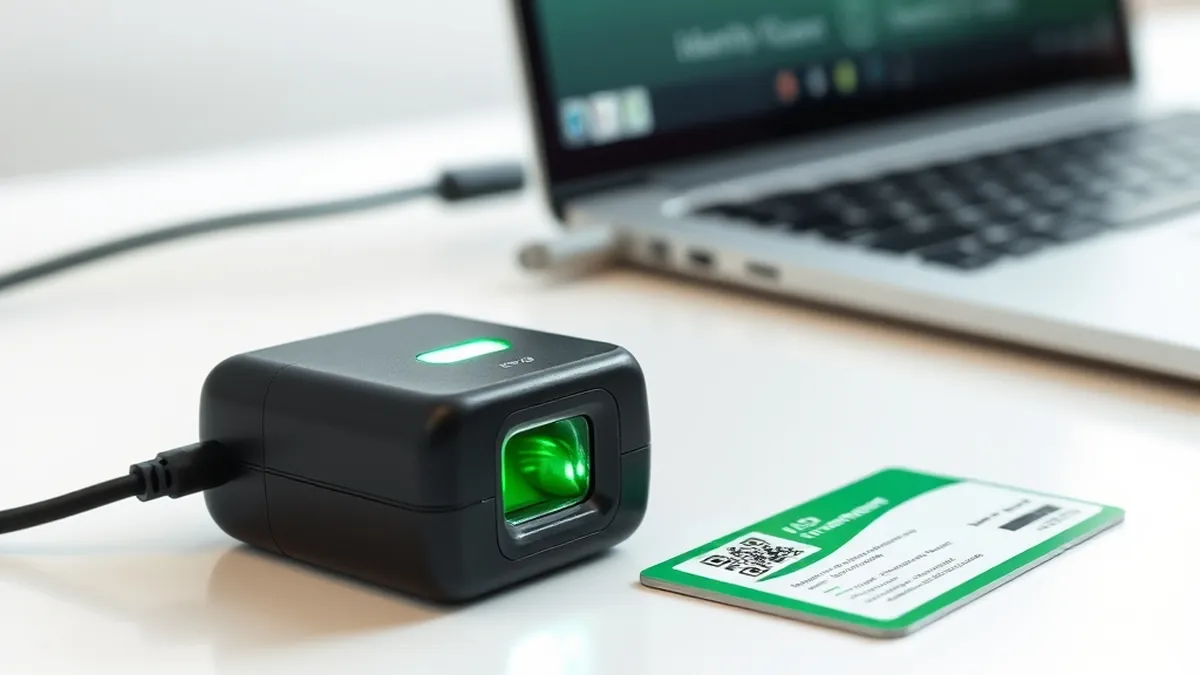
Biometric Fingerprint Scanners in Pakistan: NADRA Verification, Land Records & Schools (2026 Guide)
If you have been to a bank, a franchise for a new SIM, a land record centre or even a government school lately, you have probably pressed your thumb on a small glowing scanner. Fingerprint verification is no longer something only NADRA does. In 2026 it sits at the front desk of half the offices in Pakistan, and many of them are still buying their first devices or replacing old ones that keep failing.
We get calls about this every week: a patwari office that needs ten scanners before an inspection, a school that has been told to start biometric attendance, a software house building a verification module for a hospital. So we wrote down what we tell them. This guide covers where these scanners are used, the specs that actually matter, and which model fits which job.
Why biometric verification is suddenly everywhere
NADRA sits at the centre of it. It offers identity verification to the public and private sector through services like Biometric Verification (BIOSYS), which matches a person's fingerprints and photograph against their CNIC record, along with Verisys for CNIC checks and batch verification for large backlogs. NADRA has talked about facial recognition as a backup for people whose fingerprints fail, but the fingerprint is still the everyday workhorse.
Telecom moved first. Since December 2022 SIMs have been issued through the Multi Finger Biometric Verification System (MBVS). The system, not the shopkeeper, picks two random fingers, which makes silicone fake fingerprints far less useful. Banks, exchange companies and courier services followed with their own NADRA-linked checks.
Now the provinces are doing the same with land, education and health. Each of these departments needs a reliable USB fingerprint scanner that works with their software, and that is where most buyers get confused.
Where these scanners are used in government departments
Land record centres and property registration
Land fraud is one of the oldest problems in Punjab, and biometric verification is the main tool being used to fight it. The Punjab Land Records Authority (PLRA) runs Arazi Record Centres where the seller and buyer verify their identity before a fard or mutation is processed. A draft amendment to the Registration Act 1908 goes further: it gives the PLRA an electronic registry and writes "biometric verification" into the law for property deeds.
Alongside this, the Board of Revenue's World Bank-supported PULSE (Punjab Urban Land Systems Enhancement) project is building a unified land information system with digital deeds and parcel maps for urban property. PULSE even hosts a public SecuGen fingerprint scanning demo on its own domain, which tells you which device family its systems are built around. For land offices, the SecuGen Hamster Pro 20 and HU20 series are the safe choice.
Schools and education departments
In July 2026 Punjab's School Education Department told district education authorities to install biometric attendance and CCTV in about 38,000 government schools. Some schools use wall-mounted attendance machines. Many district offices and school management systems instead use a USB scanner plugged into a PC or tablet, so a teacher's attendance is logged straight into the online system. Student registration also relies on parents' CNICs, which are checked against NADRA.
For this kind of daily, high-volume use, look for a rugged sensor that handles dusty and dry fingers, plus Android support if the school uses tablets. The ZKTeco ZK9500 and Xperix BioMini Slim 2 both do well here.
Hospitals, health cards and medical software
More and more hospitals link each patient's medical record to their CNIC, so the same person is not registered twice and health-card treatment goes to the right person. Hospital management software (HMIS) uses a fingerprint scanner to confirm the patient at the OPD counter, to release health-card treatment, and to log doctors and staff in and out. What matters most here is SDK support: the scanner has to be one your software vendor already supports, otherwise it will just sit in a drawer.
NADRA-linked verification counters
Banks, microfinance, telecom franchises, courier and exchange companies and e-Sahulat style service points all verify customers against NADRA through their own approved software. These setups usually ask for an FBI-certified 500 DPI optical scanner, so SecuGen and BioMini models are a common sight at these counters.
What specs actually matter
A recent NADRA tender for fingerprint readers is a good checklist, because it lists what a government buyer actually asks for:
- 500 DPI or higher with 256 grey levels. Anything lower can fail matching against the national database.
- Standard image and template formats: ISO 19794-4 images, ISO 19794-2 / ANSI 378 templates and WSQ compression. These let the same scanner work with different software.
- Fake finger (spoof) detection: it rejects silicone and printed fingerprints.
- FBI PIV / FAP 20 certification: an independent image quality standard. If your software vendor says "use a certified scanner", this is usually what they mean.
- USB 2.0, bus-powered, working on Windows 10/11. Android support is a bonus for tablets.
- SDK and drivers for .NET, Java or Android, so your developers can integrate it.
One practical tip: before buying in bulk, ask your software provider which scanner models their system has drivers for. Most problems we see are not faulty devices but a scanner model the software was never built for.
Fingerprint scanners we stock for government and office use
SecuGen Hamster Pro 20
The scanner most government and banking software in Pakistan is built around. It has a 500 DPI optical sensor, FBI PIV and Mobile ID FAP 20 certification, IP54 water and dust resistance, fake finger rejection and a 0.2 to 0.5 second capture. SecuGen provides free SDKs for Windows, Linux and Android. If you are not sure which model to buy, buy this one.
SecuGen HU20 and SecuGen HU20A
These are model numbers within the Hamster Pro 20 family. They have the same 500 DPI sensor, 300 x 400 pixel image and Smart Capture, and SecuGen says the API is the same across versions. Some departmental software and tender documents name an exact model, so we keep both. With SDK-based software they support Auto-On, which starts the scan as soon as a finger touches the sensor. That helps at busy counters.
SecuGen Hamster Pro (HUPx)
The earlier Hamster Pro model, still asked for by offices running older verification software built on that driver. If your system was installed a few years ago and the old scanner has finally died, this is often the direct replacement that works without reinstalling anything.
Xperix BioMini Slim 2
Formerly sold under the Suprema name, the BioMini Slim 2 is a slim, FBI PIV and FAP 20 certified optical scanner with a 500 ppi, 256 grey-level image. It connects over USB 2.0 High Speed and comes with SDKs for Windows, Linux and Android. It is a strong alternative wherever your software lists BioMini or Suprema devices.
ZKTeco ZK9500
A budget-friendly 500 DPI optical scanner on USB 2.0, supported by ZKTeco's ZKFinger SDK. It is a good fit for school attendance, staff login and in-house software built on the ZKTeco SDK. If your system already uses ZKTeco attendance machines, the ZK9500 keeps everything in the same ecosystem.
Quick buying guide
- NADRA, bank and telecom verification: SecuGen Hamster Pro 20 or BioMini Slim 2.
- Land record and registry offices: SecuGen Hamster Pro 20 / HU20 series.
- Replacing an old SecuGen on legacy software: Hamster Pro HUPx or HU20.
- School and staff attendance, tablets: ZKTeco ZK9500 or BioMini Slim 2.
- Hospital and medical software: whichever model your HMIS vendor lists, which is usually SecuGen or BioMini.
Frequently asked questions
Which fingerprint scanner works with NADRA verification?
NADRA verification runs through the software of the bank, telecom company or department you work with, and that software decides which devices it supports. In practice, FBI PIV / FAP 20 certified 500 DPI scanners such as the SecuGen Hamster Pro 20 and BioMini Slim 2 are the safest bet. We sell the hardware only. NADRA access itself comes through your institution's approved software and credentials. Always confirm with your software provider before bulk orders.
Can I use these scanners with an Android tablet?
SecuGen and BioMini provide Android SDKs, so they work over USB OTG if the app is built for that device. For any scanner, check with the app developer first.
Do you supply bulk orders for government departments and schools?
Yes. We supply offices, schools and software houses across Pakistan with genuine, sealed units with a 12-month warranty, cash on delivery and invoices for procurement. Message us on WhatsApp at 03209492059 for bulk pricing and stock.
Not sure which scanner your software needs? Send us the software name on WhatsApp and we will tell you the compatible model before you buy. You can also browse every fingerprint and attendance device in our biometric range.
Need help choosing the right product?