Punjab Ration Card 2026: Rs 3,000 Monthly, Who Gets It, How to Use & Avoid Scams
The Punjab Ration Card (also searched as "Rashan Card") is one of the most searched welfare topics in Pakistan right now. It gives registered workers Rs 3,000 of groceries every month at registered shops. In July 2026 the Punjab government approved another Rs 43.2 billion to keep it running in financial year 2026-27, and by then 1,244,130 cards had been issued to 1,403,063 registered workers (The Express Tribune, 28 July 2026).
There is also a lot of confusion. Many websites mix it up with BISP 8171, the old Ehsaas Rashan Riayat, the Ramazan Nigehban package or PSER registration, and some ask people to "apply online" through unofficial links. This guide explains what the card is, who gets it, how it is used at a shop and how to stay safe. At the end there is a short section for karyana shop owners who want a faster, more organised counter.
What is the Punjab Ration Card?
It is a bank card loaded with a grocery subsidy of Rs 3,000 per month, which works out to Rs 36,000 a year. Cardholders buy essential food items such as flour, rice, sugar, ghee or cooking oil and pulses from shops registered for the programme. As of July 2026, about 62,000 shops across Punjab were part of it.
| Detail | What the reports say (2026) |
|---|---|
| Monthly value | Rs 3,000 of essential groceries |
| Run by | Punjab Employees Social Security Institution (PESSI), Labour & Human Resource Department |
| Card issued by | The Bank of Punjab prints and delivers the cards |
| Cards issued | 1,244,130 (July 2026) |
| Registered shops | About 62,000 across Punjab |
| Funding for 2026-27 | Additional Rs 43.2 billion approved |
| Also covered | Over 100,000 Suthra Punjab workers; mine workers through the Mines & Minerals Department |
In Ramazan 2026, cardholders received Rs 10,000 instead of the usual Rs 3,000 as part of the Ramazan package (Dawn, 9 March 2026). That was a one-time increase, not the regular monthly amount.
Who is eligible?
In practice, the cards have gone to workers registered with Punjab Social Security (PESSI). PESSI has opened bank accounts for more than 1.2 million of them. If your employer has registered you with PESSI and pays your social security contribution, you are in the group the card is meant for.
An older Punjab government page described the programme more broadly, for low-income households with a PSER poverty score under 35, monthly income under Rs 50,000, no government job and no BISP payment. News reports from 2025 and 2026 only describe distribution to registered workers. If you are not a registered worker, check with the official helpline before assuming you qualify.
Punjab Ration Card vs BISP 8171 vs Ehsaas Rashan
| Programme | Run by | What it is |
|---|---|---|
| Punjab Ration Card | Punjab (PESSI + Bank of Punjab) | Rs 3,000/month grocery card for registered workers |
| BISP / 8171 | Federal government | Cash support to eligible families; status checked via 8171 |
| Ehsaas Rashan Riayat (2022) | Federal government | Earlier subsidy scheme; no longer running in its original form |
| Ramazan Nigehban package | Punjab | One-time Ramazan support; not a monthly card |
| PSER | Punjab | Socio-economic registry of households used to target several Punjab schemes |
Sending your CNIC to 8171 checks BISP status, not the Punjab Ration Card.
How do workers get the card?
There is no separate public online form for the ration card. It comes through your social security registration:
- Employer registers with PESSI and pays the monthly social security contribution.
- You are registered as a worker. PESSI issues your social security card. Domestic workers have their own registration route.
- Your details are kept up to date: CNIC number, CNIC expiry and a mobile number registered on your own CNIC.
- PESSI opens your account and the Bank of Punjab delivers the card. A Ration Card Cell at the PESSI head office in Lahore handles issue and monitoring.
- The monthly subsidy is credited and you spend it at registered shops.
If your card has not arrived, ask your employer's HR to check your PESSI record first. Wrong CNIC dates or a mobile number registered in someone else's name are common reasons for delays. Then contact your local Social Security Directorate office.
How to use the card at a shop
- Ask the shopkeeper first whether the shop is registered for the Punjab Ration Card.
- Carry your original CNIC with the card. Registered shops verify the cardholder before the purchase.
- Keep the card in your own hands and never tell anyone your PIN. Do not leave the card at the shop "for next month".
- Check prices against nearby shops and confirm the total before paying.
- Ask for a receipt and check your remaining balance.
Common scams to avoid
- "Apply online" websites and WhatsApp links asking for your CNIC, card number or PIN. The card comes through PESSI registration, not a public form.
- Agents charging a fee to "get your name on the list". Registration through your employer and PESSI does not need a middleman.
- Calls claiming to be from the bank or PESSI asking for an OTP or PIN. Hang up and call the official number yourself.
- Shops giving fewer items or charging more against the card. Note the shop name and address and report it.
For official information, use the PESSI website (pessi.punjab.gov.pk), the PESSI helpline 0800-73774 or your nearest Social Security office. The Punjab government's helplines page lists 1105 for the ration card. Confirm the number there before you call. Ignore numbers that only appear on social media posts.
For karyana shop owners: a faster, cleaner counter
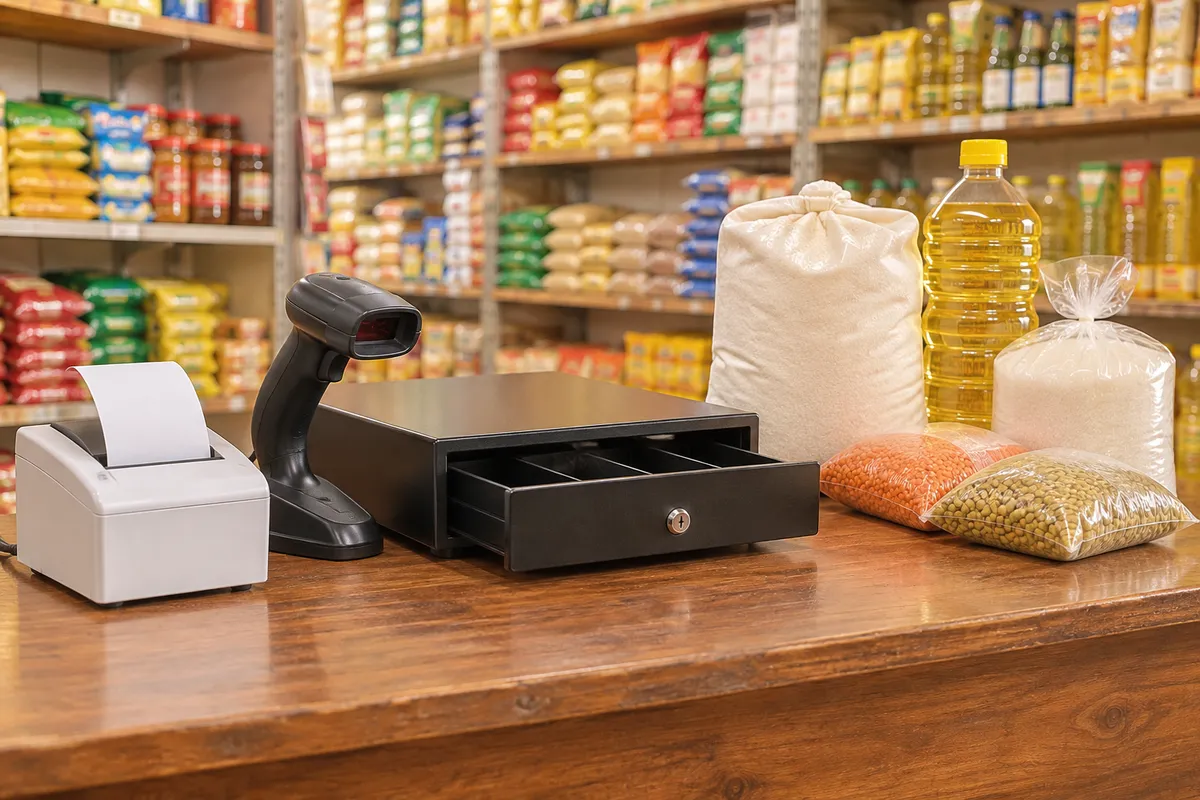
With tens of thousands of shops in the programme and more customers paying by card, QR and wallet, many karyana stores are also upgrading the rest of their counter. To be clear: ration card transactions are processed only on the system and device provided by the participating bank. The products below are not ration card devices and are not part of the programme. They are general shop equipment that helps you bill quickly, give printed receipts and keep cash organised.
Receipt printer
A printed receipt with item names and totals builds trust with every customer, including cardholders who want to track their balance. An 80 mm printer such as the Speed-X SP-210UL 80mm USB + LAN or the Black Copper BC-88AC suits a fixed counter with billing software. For a small shop or a delivery boy, a portable Bluetooth printer such as the Goojprt PT-210 (48 mm paper, rechargeable battery) or the Speed-X BT450M prints from a phone app.
Barcode scanner
Scanning packaged goods is faster than typing prices and avoids billing mistakes in busy hours. A basic 1D scanner such as the Speed-X 8400 reads product barcodes. A 2D scanner such as the Speed-X 8600 with stand or the Black Copper BC-1110QR also reads QR codes.
Cash drawer and cash counter
A lockable cash drawer such as the Speed-X SP-340B (7 bill / 4 coin, RJ11) or the Black Copper BC300 connects to the receipt printer and opens when a sale is printed. Wholesale and larger shops that handle bundles of notes can use a counter with fake-note detection such as the Speed-X SP-620. Our cash counting machine guide explains how detection works.
All-in-one options
If you don't want a computer at the counter, a cash register machine or a handheld Android terminal such as the Sunmi V2 Pro (5.5" screen, built-in 58 mm printer, 4G and Wi-Fi) keeps billing in one device. For a full setup with software, see our FBR POS setup guide.
| Shop size | Suggested counter setup | Approx. cost |
|---|---|---|
| Small karyana | Portable Bluetooth printer + 1D scanner | Rs 10,000 – 11,000 |
| Medium store | 80 mm printer + 2D scanner + cash drawer | Rs 22,500 – 24,500 |
| Busy or wholesale | 80 mm printer + 2D scanner + cash drawer + cash counter | Rs 42,000 – 45,000 |
FAQ
How much is the Punjab Ration Card per month?
Rs 3,000 of essential groceries per month, according to 2026 reports. During Ramazan 2026, cardholders received Rs 10,000.
Can I apply for the ration card online?
No public online form has been announced. Workers get the card through their PESSI social security registration. Be careful with websites that ask for your CNIC and PIN.
Is 8171 used for the Punjab Ration Card?
No. 8171 is the federal BISP service. The Punjab Ration Card is run by PESSI and the Bank of Punjab.
Where can I use the card?
At shops registered for the programme, about 62,000 across Punjab as of July 2026. Ask the shopkeeper before shopping.
Can a shop accept the card on any POS machine?
No. Ration card transactions run only on the system provided by the participating bank. Regular receipt printers, scanners and cash drawers help with everyday billing but do not process ration card payments.
Programme details can change. Figures here come from news reports by The Express Tribune and Dawn (March–July 2026). Always confirm eligibility and helpline numbers with PESSI or the Punjab government before acting.
Need help choosing the right product?